Juggernauts, Upstarts, and Slumping Giants
A midseason check-in with the biggest teams and storylines in college volleyball


- The NCAA Volleyball season is roughly half finished and it is becoming clear who might challenge for major prizes at the end of the season and who will look to next year for renewed hope.
- Nebraska and Pitt have largley met expectations but will face intense pressure as the season continues and they pursue a long awaited title.
- SMU and Washington have defied expectations so far while Penn State and Stanford have scuffled and must hope to rebound in the second half.
As we hit the halfway point in the season, teams are reaching the stage where the wheat separates from the chaff. For some, early-season hopes are coming to fruition, others are playing beyond than their wildest dreams, and for an unlucky few, those dreams have become waking nightmares.
The Usual Suspects
Two familiar powerhouses top the AVCA rankings. Pitt, which has reached five straight Final Fours but not a championship game in that span, and Nebraska, which hasn't won a national championship since 2017 despite not losing a regular-season game since 2024, have dominated the first half of this season. Both programs are hoping they've got the formula right this season to win when it matters most.
No. 1 Nebraska (15-0)
Wherever Nebraska volleyball goes, it sets attendance records. 15,127 fans came out to watch the Terps get swept by Nebraska in Maryland, setting the school attendance record for a volleyball match. The hype around them is massive, and until they show any sign of weakness, they are the team to beat.
Nebraska is led by a trio of First-Team All-Americans: setter Bergen Reilly, outside hitter Harper Murray, and middle blocker Andi Jackson. Bergen Reilly has been named Big Ten Setter of the Year three times, and Andi Jackson was named the nation's best middle blocker last season. Laney Choboy, the team's other senior, plays a defensive specialist role and often delivers jaw-dropping plays.
Beyond the immense talent leading the team, Nebraska's greatest strength may be its versatility. As a team, they have the best team hitting percentage at .326 and the best opponent hitting percentage at .101. They can spread the offensive and defensive load across all players on the floor, making them nearly impossible to defeat.
With the NCAA's 5-for-5 ruling granting each senior an extra year of eligibility, will Nebraska reach the mountaintop this year, and will all the seniors return next year to keep the party going?
No. 2 Pittsburgh (14-1)
Pitt began the season ranked fourth and went on to win their first 14 matches, including ten sweeps. Despite the Panthers' perennial dominance, a loss to a very good No. 6 SMU was in the cards on October 7th. That leaves them 6-1 against ranked opponents and 2-1 against top-ten teams.
The Panthers are headlined by one of the country's best setters, Izzy Starck, a Penn State transfer, who helps facilitate arguably the country's best player, Olivia Babcock. Starck averages 10.8 assists per set and has 529 assists so far. At 6'4, senior opposite hitter Olivia Babcock is one of the country's most complete players and leads the nation in Kills Per Set at 5.31. She’s already a two-time AVCA National Player of the Year and is putting a strong case together for a third. Babcock has announced she will return to Pitt for her fifth season regardless of the results come December.
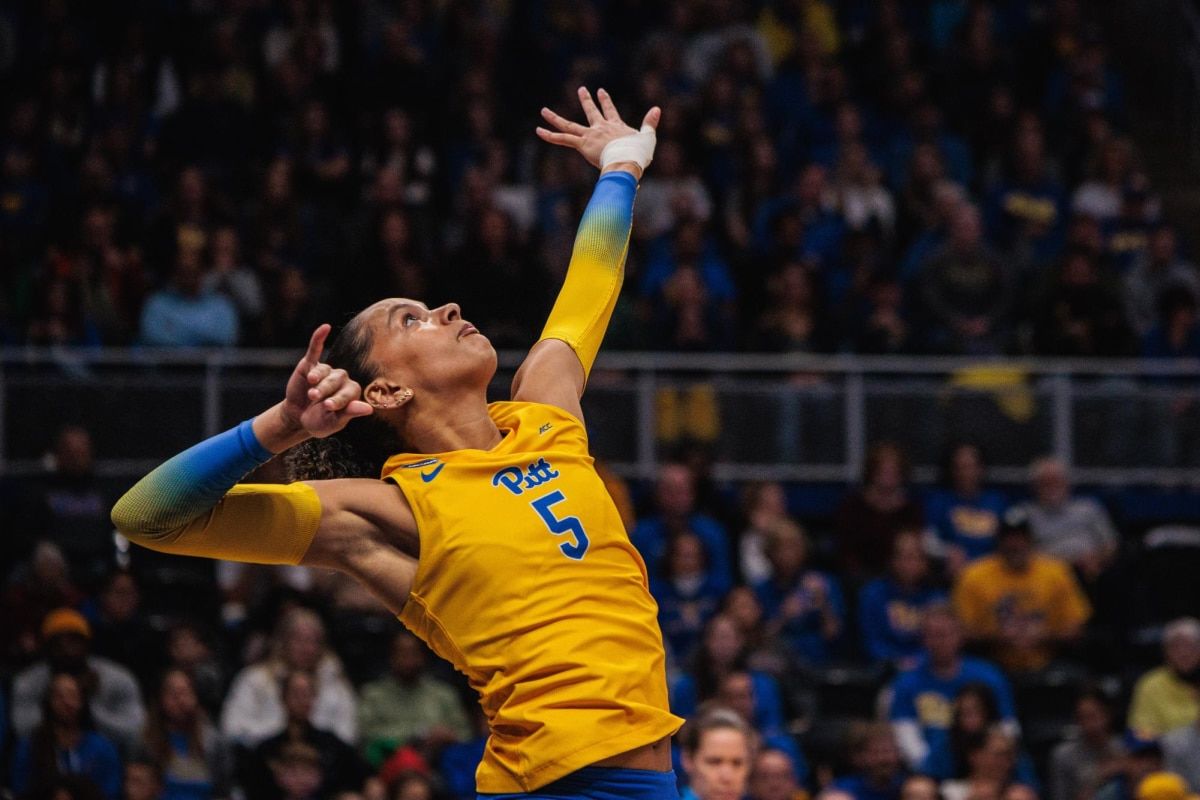
Despite Pitt’s star power, what might make the difference down the stretch is the experience, camaraderie, and hunger built over years of heartbreak.
“We have a want-to versus have-to culture, and that's something we talk about every day,” said Babcock on the Welcome to the Party podcast with Billie Jean King. “We're all in the gym not because we have to be there but because we want to and we want to win. Every single day it's very clear that everyone wants to be the team that can get over that hurdle at the end of the year.”
Pitt will seek revenge against SMU this weekend in a rematch in Dallas.
Exceeding Expectations
SMU and Washington are among the teams whose strong play pushed them up the rankings.
No. 6 SMU (12-2)
The AVCA ranked the Mustangs 11th heading into the season but firmly cemented themselves as a top-six team. Their incredible start featured impressive wins over No. 3 Kentucky, No. 8 Texas A&M, No. 12 Stanford, and No. 9 Texas in a hard-fought five-set affair.
The season's highlight so far came on Wednesday, October 7, when the Mustangs beat Olivia Babcock’s Panthers in Pittsburgh. Pitt beat SMU convincingly in the first set, but the Mustangs responded to win the final three sets, including a 38-36 third set.
Head Coach Sam Erger and the players and her players have embraced the high-risk, high-reward schedule as part of the team’s identity.
“There's a risk with such a tough schedule, but the hope is that you either have a really good win or a not bad loss," said coach Erger. “Adversity is coming. We might not win every match, of course we want to, but this is to prepare us for the future.”
SMU is a solid all-around team with few offensive or defensive weaknesses. Standout players like Suli Davis, the sophomore outside hitter who transferred in from BYU, have shown up when it matters most, with 22 kills against Texas, 25 against Kentucky, and 17 against Pitt. They also rely heavily on middle blocker Natalia Newsome, who currently has the nation's highest hitting percentage at .523 and .95 blocks per set. Not to be outdone, Favor Anyanwu shares the load at middle blocker and ranks fifth in the country in blocks per set with 1.59.
In what will be must-see TV, the rematch is scheduled for this weekend at home. If they can push the Panthers to the limit again, or even come away with a second win, it will be hard to consider them anything but a serious title contender. Watch this space.
No. 20 Washington (12-1)
Washington has been one of the biggest surprises in the NCAA for all the right reasons this season. Washington had a losing record last season and has had a losing record in conference play for the last three seasons. It was unsurprising that they began the season unranked with almost no media attention.
Fast forward to October 2. The Huskies are ranked for the first time since 2024. They’re 12-0, having just beaten the Spartans and the Wolverines in Michigan to begin conference play, and they’re preparing for a home game against Illinois. It also marked the first time they had broken into the AVCA rankings, at No. 22, since October 24. Confidence could not have been higher.
Such is sports: Illinois defeated Washington in straight sets, and you'd be forgiven for thinking that marked the end of the magic. They almost didn't make it into this article following that performance. With a game two days later against No. 10 overall Purdue, things seemed bleak.
In a huge test of their resilience, Washington bounced back to upset the Boilermakers in straight sets. By the end of the weekend, they moved up another two places in the rankings to No. 20.
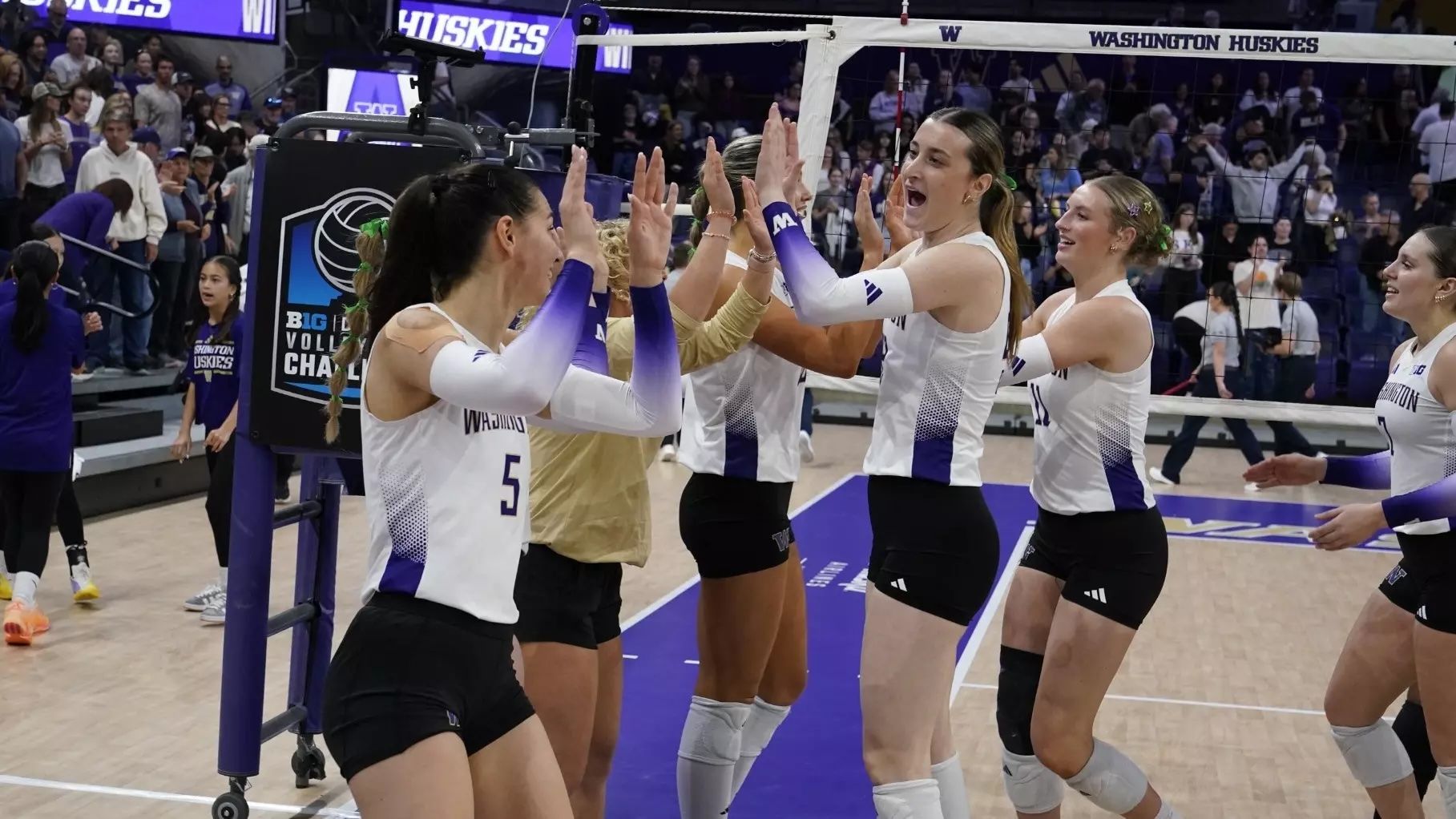
If Washington is to be feared this season, they will have to do more to prove themselves. For better or worse, they will have every opportunity to do so playing tough Big Ten opponents for the remainder of the season. Whatever happens, this team has already outperformed expectations, is set for an exciting second half, and looks like a sure bet to be a thorn in the side of the major powers down the stretch.
Falling off track
For schools like Stanford and Penn State, a season that began with so much hope has become a painful slog. These schools still have time to get back on track, but they will need to act fast.
No. 14 Stanford (9-5)
Stanford entered the season ranked 5th overall, just one spot below Pitt. The ACC’s preseason coaches’ poll tipped them to win the conference. They have since lost five games, matching the most of any other ranked team at this point in the season, and dropped to 14th in the country.
They started the season strong with back-to-back ranked wins against No. 6 Wisconsin and No. 15 Kansas. Since then, they lost to all five ranked opponents. As the season has progressed, it seems likely that the team from Palo Alto, California, the root of their struggles, may not show up in the box scores after the match. The Conference realignment may be taking a toll.
Stanford, located less than 30 miles from the Pacific Ocean, is playing its third season in the now somewhat ironically named Atlantic Coast Conference (ACC). Playing the likes of Pitt, Louisville, and SMU challenging enough. Add to that the load of a Stanford education and an estimated 15,564 miles traveled so far this season, and it's hard not to sympathize with the Cardinal players. They have already traveled nearly 10,000 miles more than the NCAA average. In the second half of the season, they are expected to travel an additional 20,000 miles.
Players have alluded to this frustration, with Julia Blyshove posting a selfie on TikTok with a caption that read, “We just lost. It’s 11pm. We leave at 4:45 am to fly back on our OFF DAY. And we have class to go to!” The next post featured her and some exhausted-looking teammates in backpacks in an elevator, with a timestamp reading 4:53 am and a caption reading, “Finished playing 6 hours ago!”
It’s been a disappointing start, but the talent present in the Stanford locker room offers hope that they can overcome these unique challenges and produce a strong second half. In a difficult conference and a sizable hole, Stanford faces an uphill battle to achieve anything close to what they expected before the season began.
No. 18 Penn State (10-4)
During their title defense last season, Penn State played to a disappointing 19-13, good enough for sixth place in the Big Ten, before exiting in the second round of the NCAA tournament.
Hoping for a better season in 2026, the Nittany Lions added middle blocker Ryla Jones from Pitt, and veteran outside hitter Whitney Lauenstein from Texas via the transfer portal. They also added Florida’s star setter Alexis Stuckey, who played alongside two-time All-American Kennedy Martin before transferring to Penn State last season. The new blood and old bonds sparked optimism for a potential rebound season.
The results have been underwhelming so far. With a 10-4 record and 2-2 in Big Ten play, the team remains afloat. Halfway through the season and ranked No. 18 in the country, they remain a work in progress and hope for improvement moving forward.
“I think we've learned a lot so far in the season, and I think that I think the team is getting better, and that's the goal,” Coach Schumacher-Cawley said recently. “Every time we step on the floor, to be a better team, we're trying just to get the best out of each position we can right now.”
They have had some bad luck, with Jones injuring her knee in the second game of conference play. At the time of the injury, Jones offered consistency, leading the team in hitting percentage at .381.
The problem doesn't seem to be a lack of talent, but a lack of chemistry on the floor. Despite an impressive transfer haul, Penn State still struggles to pass efficiently and avoid errors consistently.
The Nittany Lions hope Coach Schumacher-Crawley's experimentation yields a more reliable formula and strong performances for the remainder of Big Ten play.