Stars and Stoppages: The Women Powering Flag Football’s Rise to the Olympic Stage
The Athletes and Support Staff Leading the way into 2028 LA
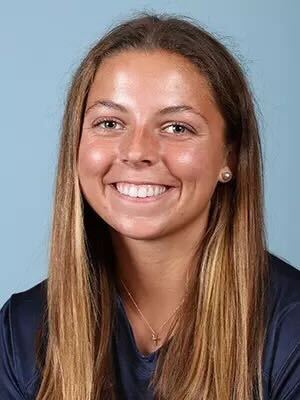

In January 2022, Madison Fulford picked up a flag football belt for the first time. A former NCAA track-and-field athlete who was serving in the Air Force, she joined an intramural team on base on a whim.
She was hooked right away. “I was like, holy shit, this is bad-ass,” she laughs. “There’s thousands of girls playing and mossing people. You get all the same things the boys are doing — but girls are doing it.”
Six months after trying the sport, she caught the attention of USA football and was recruited to the U.S. National Team. By the end of the year, she had caught all four touchdowns in Team USA’s gold-medal win against Mexico, and become one of flag football’s biggest names.
But if Fulford is rare in her talent, she is hardly alone in her passion for this fast-growing sport. Across the country, flag football has evolved from grassroots enthusiasm to sanctioned college programs and international championships.
Seventeen states now recognize girls’ Flag as a high school sport, and college programs are following suit. The NAIA and junior colleges already crown national champions each spring, and Conference Carolinas in Division ll recently became one of the first NCAA-affiliated leagues to sponsor the sport. Flag football will be highlighted in the 2028 Olympics, in Los Angeles.
Still, as an emerging sport, flag football is in the process of establishing its structures and rules. The NCAA games play 7-on-7, while the Olympic version will be 5-on-5 on a smaller field. Officials must stay abreast of developments and adapt to each—as well as learn the cultural rhythms of a truly global game, where pace and style can look very different depending on the country.
That’s where Desiree Abrams, Head of Officiating for the Women’s National Football Conference (WNFC) and founder of the National Women’s Football Officials Association (NWFOA), steps in. She’s working to build systems and structures that will put the sport on a strong foundation.
Abrams’s Flag journey began where Fulford’s did: with a love for playing.
“The first time I was introduced to flag football was in high school powder-puff,” Abrams says. “That experience catapulted me into exploring football as a woman, because as far as I knew there were no women’s leagues. Catching the ball, making a tackle—I understood why guys loved the game so much, and I wanted more of it, but I wanted to do it with women.”
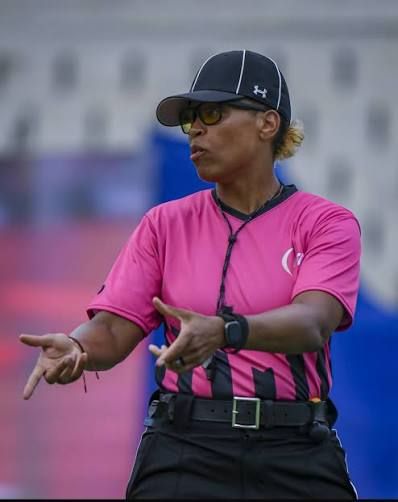
Abrams has worn nearly every hat—player, coach, official—on her path to leadership in this fast-growing sport. Her motivation to support Flag’s expansion with clear strong rules arose from these many perspectives.
“As a player, you think you know the game, but you don’t know it from the rules aspect, ” she says. “Once I learned it, I realized officials are there to serve the game. We’re stewards of it.”
As a player, Fulford, too, understands that for Flag to truly take hold and grow will depend as much on refs and regulators ensuring fair and competitive playing fields as on the competitors lighting up those fields.
“We need coaches to have more flag knowledge,” she says. “Some still teach tackle things, but it’s not the same. People need to separate regular football from flag football — they’re two completely different sports.”
Abrams is preparing the game’s infrastructure to match its momentum. The NWFOA she founded focuses on training and certifying referees in both women’s tackle and flag football, while the WNFC she heads is one of the nation’s premier women’s tackle football leagues. Together, the two organizations are supporting league expansion with systems to sustain it.
“There’s been no such thing as a flag-football official except recently,” she says. “With all the new NCAA programs, there will be a lot of schools that need officials who are properly trained — and we don’t have them yet.”
“We’ve trained at the Olympic level, the NFL Flag level, and now the collegiate level,” she adds. “We hope to be the example for every conference that joins the fold.”
Both women see Los Angeles 2028 not as a finish line, but rather as a beginning — a stage big enough to hold the visibility they’ve fought for and the structure they’ve built.
“So many little girls come up to me at games wanting to be just like me — but they can also be just like them,” says Fulford. ““They can be their own selves and flourish in the sport.”
Fulford now runs MAD Skills Training, a youth-development initiative that brings flag football to girls. “Growing up, this stuff simply wasn’t accessible to me,” Fulford says. “Now these girls get to see themselves and what they could be.”
Fulford’s true impact to the game shows not in her highlight plays, but in those kinds of moments, ensuring that young girls never have to question whether they deserve a place in the game.
Abrams, no longer actually on the field, carries the same love of the game into everything she does to ensure the foundation is there for players like Fulford, and generations to come.
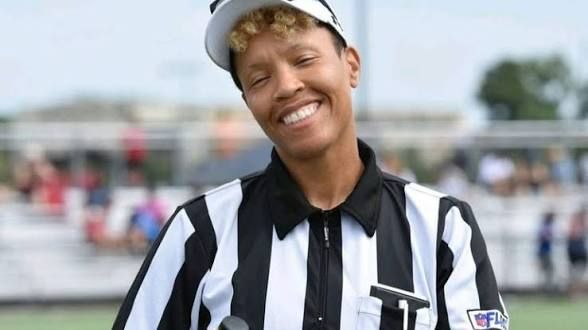
“I understand what the coaches go through, the dedication it takes to make a gameday happen.. We’re giving back to make sure others can play it right.” Abrams says. “I still miss playing every day, but giving back this way keeps me connected.”
Their work meets in the same place: to prove that flag football isn’t just growing, it’s being built to last.