Court Preliminarily Rules Against Quinnipiac Rugby Players
The Storied Division I program has been downgraded all the way to a club sport


Quinnipiac University sparked outrage among its players when the school demoted its Women’s Rugby Team from Division I to club status, while simultaneously adding a men’s indoor and outdoor varsity distance track program.
The rushed decision, announced after the transfer portal had closed, shocked the players.
“We are a nationally recognized, championship-caliber women’s rugby program that Quinnipiac once pointed to with pride,” commented rising sophomore and starting second-row lock Carolyn Melody. “This is bigger than one team; it is a warning sign about how easily women’s and Olympic-pathway sports can be sacrificed in this new college sports economy.”
The university stated that the decision was a result of “athletic realignment” intended to “align institutional resources with long-term competitive priorities, fiscal sustainability and the University's ongoing commitment to Title IX compliance,” according to the official press release.
Because the university intends to finish the transition before the start of next season, both current and incoming players sought an emergency preliminary injunction to maintain their Division I status for the upcoming season.
However, U.S. District Judge Kari Dooley denied the request on June 30, 2026. While Judge Dooley found there was insufficient evidence at this early pre-trial stage to meet the high standards required for an immediate emergency freeze, she clarified that the ruling was not a dismissal of the players’ case entirely. The judge acknowledged that the extensive record of internal emails, memos, and sworn player testimony raised serious questions of potential discrimination and retaliation towards Coach Becky Carlson. However, a full federal trial is required to dissect all the information, according to court documents released. This ruling allows the university to move forward.
Following the ruling, the players expressed their frustration, saying the decision overlooked the real-world impact on their lives and athletic careers.
“For our team, this decision lands like confirmation that our lives and our work can be treated as numbers on a spreadsheet, and it is deeply disappointing,” Melody said. “Yet we are being downgraded without the university producing verifiable answers on finances, Title IX or process.”
Melody’s questioning of the university’s rationale exposes a harsher reality across women’s college sports, where athletic departments facing financial pressure look to cut non-revenue women’s programs to fix their problems.
“If a program like ours can be pushed aside despite its success and institutional value, then every emerging women’s sport has reason to worry about what comes next when budgets tighten or models shift, Melody said.
Major backlash followed from the public, fans, alumni, and sports advocates, both enraged and confused by the decision. Historically, this team has been successful, winning three consecutive National Intercollegiate Rugby Association (NIRA) National Championships from 2015 to 2017.
The program even produced rugby star Ilona Maher, who starred in their three-peat era, before going on to lead Team USA to a historic bronze medal at the 2024 Paris Olympics. The victory marked the first-ever Olympic medal the United States has won in rugby sevens since it became a women’s event in 2016.
Many were confused about why Quinnipiac would move to dismantle a proven program. Maher herself was floored by the decision. Taking to social media to blast her alma mater for the demotion, posting a screenshot of the university’s announcement with a blunt caption: “Shame on you,” while also tagging both the main university’s account and their athletics account.
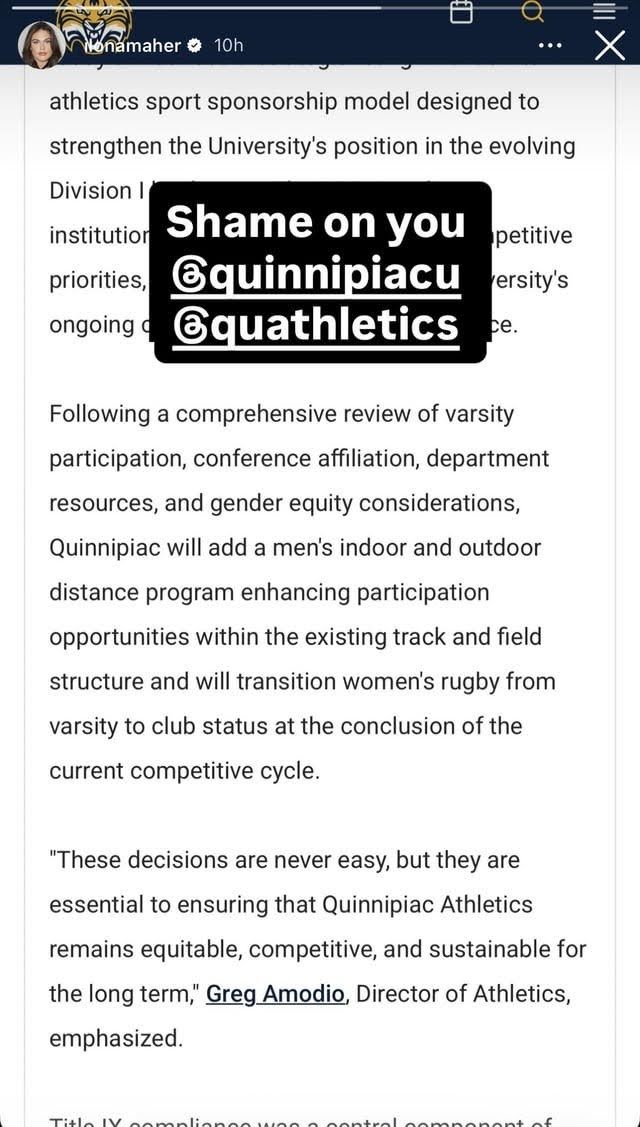
Players on the current roster were blindsided by the announcement, which was reportedly delivered during a rushed, 20-minute conference. By announcing the decision after the NIRA transfer portal had already closed for the cycle, the administration effectively trapped elite players and incoming recruits at the university, unable to transfer out for the following year.
With their athletic options stripped away, the players immediately fought back in court. On June 5, 2026, current and incoming players filed a federal class-action Title IX lawsuit against the university and their athletic department. The complaint claims three major counts: sex discrimination, unequal allocation of athletic resources, and administrative retaliation against head coach Becky Carlson. The lawsuit highlighted a significant spending gap, noting that Quinnipiac historically spent around $8,000 more in athletic expenses per male student-athlete than per female student-athlete, according to The Quinnipiac Chronicle.
While the Bobcats will be forced to play the upcoming season as a club, the players’ legal team will shift their focused towards the long-term battle. Despite the setback, players’ lead attorney Christine Brown stood firm on the team’s position.
“Given the evidence and testimony the athletes presented in court, we are extremely disappointed in today’s decision,” Brown said. “We continue to believe the record shows clearly that a successful women’s varsity program with real institutional value has been targeted while other responsibilities under Title IX and basic fairness have been ignored.”
If successful at trial, the program could potentially regain its Division I status by the 2027-2028 academic year.